
Why does your expensive set of extensions start feeling like parched straw just weeks after leaving the salon? It’s a common frustration, especially when you’re battling NYC hard water buildup or the relentless Miami humidity that turns a sleek blowout into a frizzy mess. Many people hesitate to hydrate their hair because they fear heavy ingredients will dissolve their K-tip or tape-in bonds. However, learning exactly how to use deep conditioning mask on hair extensions is the secret to stopping that dry, brittle transformation before it starts. You don’t have to choose between soft strands and secure bonds.
We understand that your extensions are an investment in your confidence, and you want them to last as long as possible. This guide will show you how to master expert techniques that revive dry hair and protect your professional treatments from damage. You’ll learn the step-by-step process for applying moisture where it’s needed most, ensuring your mid-lengths and ends stay silky, tangle-free, and perfectly blended with your natural hair for a seamless finish every day.
Key Takeaways
- Learn why hair extensions are naturally moisture-starved and how a simple two-minute porosity test determines exactly what your strands need.
- Master the professional protocol for how to use deep conditioning mask on hair extensions to ensure maximum product absorption without diluting the formula.
- Discover the essential two-inch safety rule that protects your tape-in or K-tip bonds from slipping or dissolving during your at-home treatment.
- Understand why using sodium chloride-free masks is critical for maintaining the longevity of a Silk Touch Keratin treatment against urban water quality.
- Identify the specific preparation steps required to neutralize hard water buildup and humidity-induced frizz for a silky, salon-grade finish.
The Science of Deep Conditioning: Why Extensions Require Extra Care
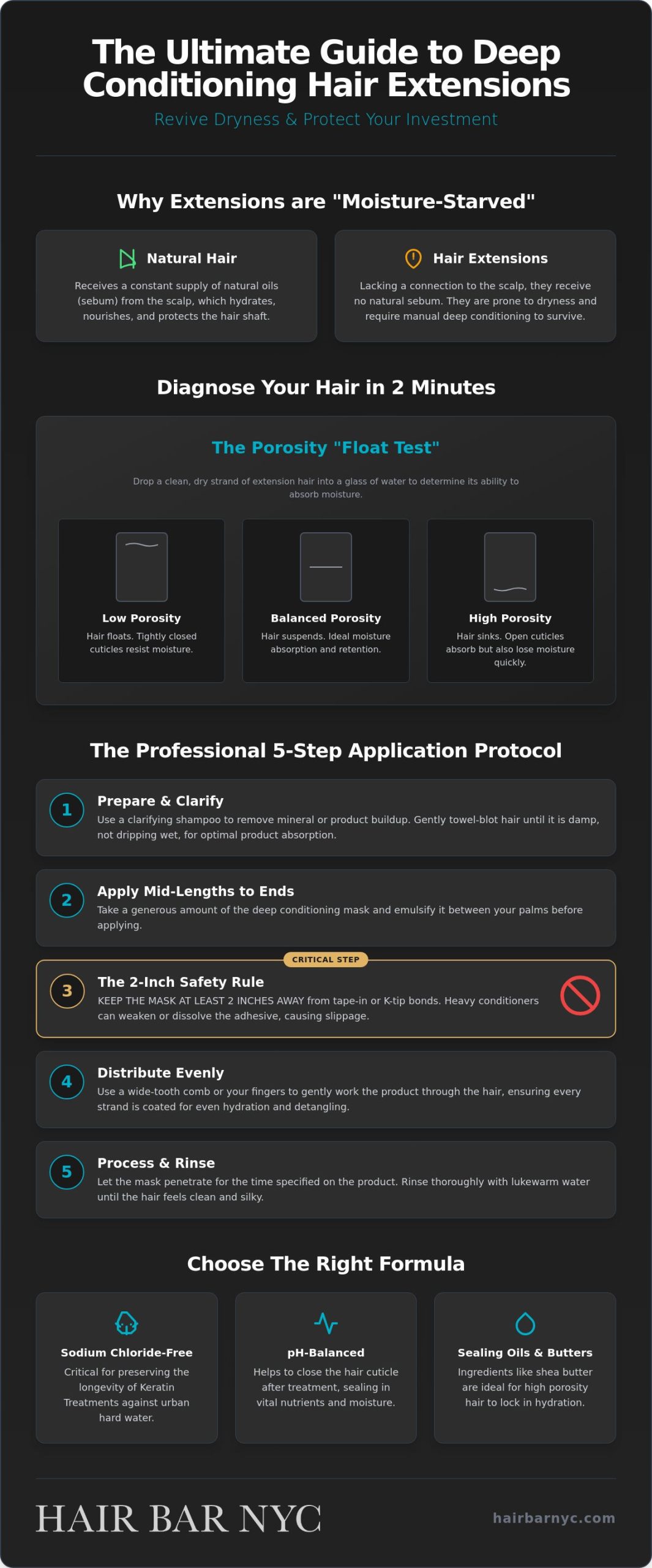
A professional deep conditioning mask isn’t just a thicker version of your daily conditioner. It is a high-viscosity treatment specifically engineered for deep cortex penetration. While standard conditioners focus on smoothing the outer cuticle, a mask uses smaller molecular nutrients to reach the inner hair shaft. This distinction is vital for anyone wearing Tape-In or K-Tip extensions. Unlike your natural hair, extensions aren’t connected to your scalp. They never receive the natural sebum that keeps hair supple and protected. They are moisture-starved by default.
Understanding The Science of Deep Conditioning is the first step in maintaining your investment. When you research how to use deep conditioning mask on hair extensions, you’re essentially learning how to manually replace the biological hydration that extensions lack. Without this intervention, the hair becomes porous and loses its elasticity. Eventually, it starts to feel like straw. Using a salon-grade Deep Conditioning Mask at home bridges the gap between your professional appointments.
Surface Conditioning vs. Deep Reconstruction
Standard conditioners usually just coat the surface to provide temporary slip. They don’t fix internal damage. In contrast, a professional mask provides deep reconstruction by filling in gaps in the hair’s protein structure. You can check your hair’s health with the “Snap Test.” Take a single strand of extension hair and gently pull it. If it stretches and returns, it’s healthy. If it snaps immediately, it needs moisture. If it stretches but doesn’t return to its original length, it likely needs a protein boost.
Urban Stressors in NYC and Miami
Geography plays a massive role in hair health. In NYC, hard water minerals like calcium and magnesium create a literal “mineral mask” over the hair. This barrier prevents standard conditioners from penetrating. In Miami, the intense UV rays act like a mild bleach. They break down the structural integrity of the hair and fade the pigment of your Balayage Artistry or Full Highlights. Knowing how to use deep conditioning mask on hair extensions correctly ensures these urban stressors don’t shorten the lifespan of your hair.
Humidity in both cities forces the hair cuticle to stay open, leading to chronic frizz. If you spend time in Florida’s salt water or pools, the dehydration is even more aggressive. This is why using a sulfate-free formula is non-negotiable. It provides a protective seal against environmental aggressors while keeping your bonds secure. Regular deep treatments help maintain the results of your Silk Touch Keratin Treatment, keeping the hair manageable despite the weather.
Identifying Your Hair Needs: The Porosity Test for Extensions
Before you apply any treatment, you must understand your hair’s unique structure. Porosity is the measure of your hair’s ability to absorb and retain moisture. It is determined by how tight or open the cuticle layer is. This isn’t just a technical detail; it’s the foundation of learning how to use deep conditioning mask on hair extensions effectively. If you apply a heavy mask to hair that can’t absorb it, you’re just wasting product. Conversely, if your hair is highly porous, it might need specific ingredients to “lock” that moisture in.
You can determine your needs with a simple two-minute experiment called the “Float Test.” Take a clean, dry strand of extension hair and place it in a glass of room-temperature water. Scientific data regarding Why Extensions Require Extra Care shows that chemical processing significantly alters the hair’s surface. If the hair sinks immediately, you have high porosity. If it floats on the surface for several minutes, you have low porosity. If it lingers in the middle, your porosity is balanced.
High Porosity: The Open Gate Challenge
Bleached or light blonde extensions often have high porosity because the lifting process leaves the cuticles wide open. While these strands absorb moisture quickly, they lose it just as fast. If your extensions tangle easily or dry almost instantly after a shower, they’re likely high porosity. You should look for masks containing shea butter or natural oils to seal the cuticle. pH-balanced formulas are also vital to help “close” the hair scales and trap the nutrients inside. If your hair feels particularly fragile, a professional Silk Touch Keratin Treatment can help reinforce those open gates.
Low Porosity: The Closed Door Challenge
Low-porosity extensions have tightly bound cuticles that act like a closed door. Product often sits on top of the hair, making it feel greasy or heavy rather than soft. To master how to use deep conditioning mask on hair extensions with low porosity, you need lightweight humectants like glycerin or jojoba oil. The professional hack for this hair type is heat. Wrapping your hair in a warm towel while the mask sits allows the cuticle to swell and open, finally letting the treatment penetrate the inner shaft. This ensures the hair stays manageable without the buildup that often plagues “invisible” extension blends.
The Professional Protocol: How to Apply a Mask for Maximum Absorption
Applying a treatment correctly is just as important as the ingredients inside the jar. If you want to master how to use deep conditioning mask on hair extensions, you have to start with a clean slate. Your hair needs to be “squeaky clean” to ensure the treatment actually reaches the hair cortex. In cities like NYC and Miami, environmental pollutants and hard water minerals create a stubborn film on the hair. Without a thorough wash using a keratin-safe formula, your mask will simply sit on top of this buildup, providing zero benefit to the inner structure of your extensions.
The biggest mistake most people make is applying product to soaking wet hair. We call this the “Towel Dry Rule.” Hair is like a sponge; if it’s already saturated with water, it cannot absorb the nutrient-rich oils and proteins found in a professional Deep Conditioning Mask. After shampooing, gently squeeze out excess moisture and blot your hair with a microfiber towel until it’s damp but not dripping. This simple step prevents the treatment from being diluted and ensures every drop of product goes toward reviving those dry mid-lengths and ends.
Step-by-Step Salon Method at Home
- Cleanse: Use a sulfate-free wash to strip away urban grime without disturbing your bonds.
- Section: Divide your hair into four manageable quadrants. This ensures no strand is left behind.
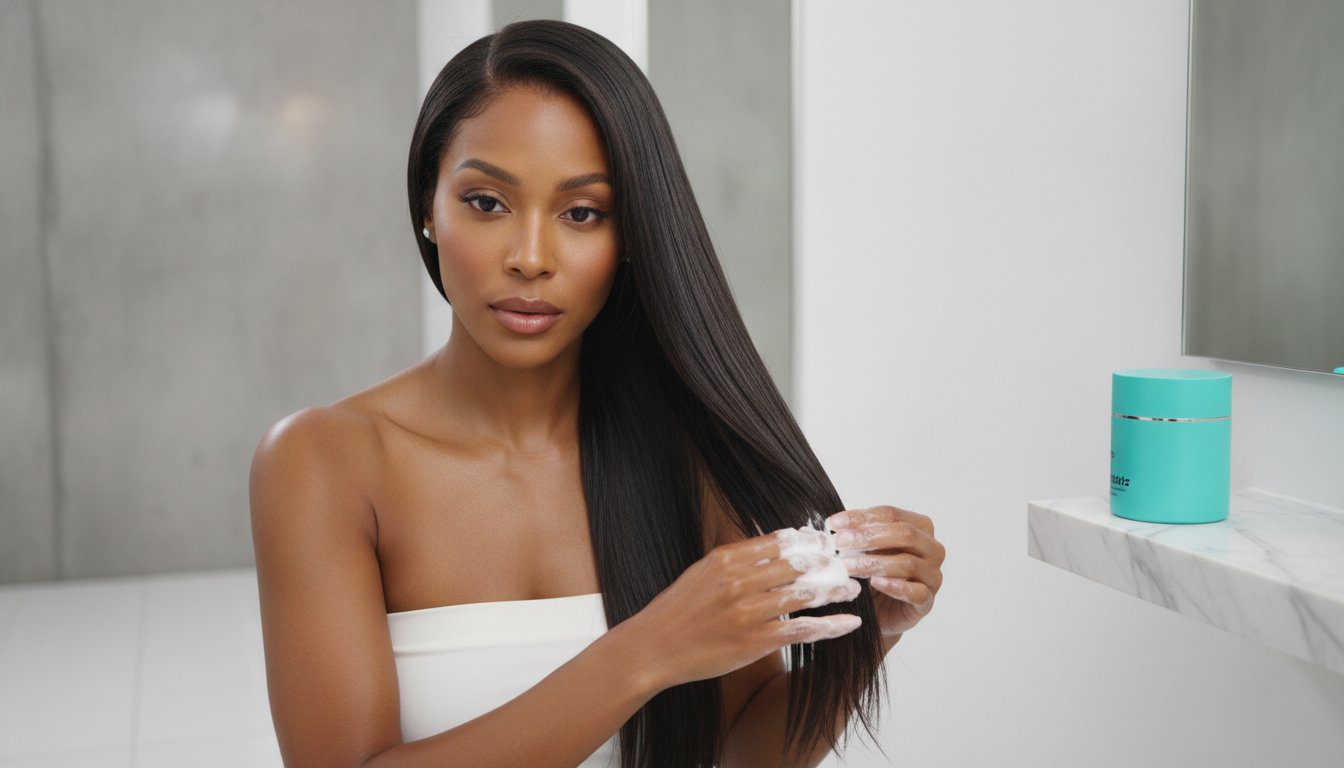
- Apply: Use the “praying hands” method. Place a small amount of mask between your palms and slide them down each section. This action helps smooth the cuticle and pushes the product deeper into the hair.
- Comb: Gently use a wide-tooth comb to distribute the mask. Start from the ends and work upward, but always stop at least two inches away from your tape-in or K-tip attachments.
- Rinse: After 20 minutes, rinse with cool water. This temperature change helps seal the cuticle and locks in the shine.
Advanced Hacks: Heat and Steam
If your extensions feel particularly like straw, you can elevate your routine with the “mini-sauna” technique. While the mask is on, wrap your hair in a warm, damp towel or use a plastic shower cap. The gentle heat encourages the hair shaft to swell slightly, which is the ultimate secret for how to use deep conditioning mask on hair extensions with low porosity. You can also let the steam from your shower do the work while you finish the rest of your body routine.
Stick to the 20-minute sweet spot. Leaving a mask on for hours or sleeping in it won’t provide extra benefits. In fact, if the mask is protein-heavy, leaving it on too long can make the hair feel brittle and stiff. Consistency is better than duration. Regular weekly treatments will maintain the longevity of your Silk Touch Keratin Treatment far better than an occasional overnight soak ever could.
Specialized Care: Protecting Bonds and Keratin-Treated Extensions
Mastering how to use deep conditioning mask on hair extensions requires a surgical approach to application. While the mid-lengths and ends of your hair are starving for moisture, the attachment points are incredibly sensitive to oils and emollients. The absolute rule for any extension wearer is to keep your mask at least two inches away from the bonds or tapes. If heavy product seeps into the adhesive of Tape-In Hair Extensions or the keratin bond of K-Tip Extensions, it can lead to slipping or premature shedding. You want to hydrate the hair, not the hardware.
This distance doesn’t mean you should ignore the hair near the root. Your scalp produces natural oils, but they rarely travel far enough to lubricate extension hair, which is essentially “disconnected” from your biological moisture source. This lack of lubrication near the attachment point is a primary cause of matting in K-Tip sets. By applying a Deep Conditioning Mask precisely from the two-inch mark down to the ends, you maintain the “slip” needed to keep individual strands from tangling around each other. This balance keeps the scalp clean while ensuring the hair remains manageable.
Maintaining Your Silk Touch Keratin
If you’ve invested in a Silk Touch Keratin Treatment, your choice of mask is critical for longevity. These treatments are specifically sensitive to sodium chloride (salt), which can strip the keratin coating and shorten the lifespan of your smooth results. Using a sodium chloride-free and sulfate-free mask can actually extend your smoothing results by up to two months. Be careful to avoid “over-proteinization.” If your hair feels stiff or “crunchy” after a treatment, it likely has too much protein and needs pure moisture instead. For more details on aftercare, read The Ultimate Guide to Keratin Smoothing Treatment.
Extension-Safe Masking Techniques
Isolating your bonds is easier when you use a clear sectioning strategy. For Tape-Ins, always apply the mask in a strict downward motion to avoid pushing product up under the tape flap. K-Tips allow for more flexibility, but the density of the hair means you must be extra thorough with your “praying hands” technique to reach every strand within the bundle. You can find more professional advice on choosing the right method in Hair Extensions NYC: The 2026 Guide.
Ready to give your strands the professional care they deserve? Shop our proprietary Deep Conditioning Mask to keep your bonds secure and your hair silky.
Elevating Your Routine with Hair Bar NYC Professional Care
At Hair Bar NYC, we believe that technical excellence in the salon is only half the battle. The real magic happens when you maintain that investment with a dedicated at-home routine. Knowing exactly how to use deep conditioning mask on hair extensions is the difference between a set that lasts three months and one that looks fresh for six. Our stylists across Manhattan and Miami often recommend a “Sunday Reset” ritual. This isn’t just a beauty habit; it’s a structural necessity. It’s a dedicated time to neutralize the week’s urban stressors, whether you’re battling the gritty pollutants of the city or the dehydrating salt air of the coast.
The “Sunday Reset” allows you to apply the professional techniques we’ve discussed, like the “Towel Dry Rule” and strategic sectioning, to ensure your extensions remain as soft as the day they were installed. By setting aside 20 minutes once a week, you’re effectively resetting the hair’s pH balance and removing mineral buildup that standard daily washing might miss. This consistent care bridges the gap between your appointments, keeping your mid-lengths supple and your ends free from the split-end fraying that often plagues high-porosity extension hair.
Shop the Professional Collection
Our proprietary Deep Conditioning Mask was specifically formulated to solve the unique problems our clients face in urban environments. Unlike generic drugstore brands that often hide heavy silicones or salts that can cause extension slippage, our formula is strictly keratin-safe, sulfate-free, and sodium chloride-free. It’s the perfect companion for our Silk Touch Keratin Treatment because it replenishes the specific nutrients that heat styling and hard water strip away. You don’t have to guess if a product is safe for your bonds when it’s designed by the same experts who applied them. Browse Hair Bar NYC Products to find the exact tools for your specific hair type and extension method.
Book Your Professional Treatment
Sometimes, even the most diligent home masking isn’t enough to combat extreme dehydration or chemical damage. If your extensions have reached a point where they feel unmanageable despite your best efforts, it’s time for a professional intervention. Combining your home routine with an in-salon Hair Botox treatment offers total rejuvenation that a mask alone can’t achieve. This service provides a more intensive concentration of nutrients delivered with professional heat tools for maximum penetration. Whether you’re visiting us in Manhattan, Boca Raton, or Miami, our specialists can assess your hair’s health and ensure your bonds are secure. Book Your Appointment Today at one of our convenient locations to experience the Hair Bar NYC difference.
Unlock the Secret to Longevity and Shine
Maintaining a flawless blend between your natural hair and extensions doesn’t have to be a guessing game. You now have the professional tools to decode your hair’s porosity and apply treatments with the precision of a stylist. By strictly following the two-inch safety rule for bonds and using the “Towel Dry” method for maximum absorption, you ensure your strands get the deep reconstruction they need without risking slippage. Mastering how to use deep conditioning mask on hair extensions is the ultimate insurance policy for your hair investment.
Don’t let NYC hard water or Miami humidity dictate the health of your hair. Our proprietary mask is trusted by stylists across our locations because it’s specifically formulated for Silk Touch Keratin aftercare. It’s completely sulfate and sodium chloride free, providing the high-grade nourishment your extensions crave. Shop our Professional Deep Conditioning Mask today to give your hair the salon-quality care it deserves. Your softest, most manageable hair is just one treatment away.
Frequently Asked Questions
Can I use a deep conditioning mask every day on extensions?
No, you shouldn’t use a deep conditioning mask every day. Extensions are prone to product buildup because they don’t shed like your natural hair. Over-conditioning can lead to hygral fatigue, where the hair becomes limp and loses its elasticity. Once a week is the ideal frequency for most extension wearers to maintain health without causing heaviness.
Will a hair mask make my tape-in extensions slip out?
A hair mask will only cause slipping if you apply it directly to the tape bonds. The oils and emollients in a mask are designed to soften hair, but they can also break down adhesive if they sit on the tape. Always keep your treatment at least two inches away from the roots to keep your Tape-In Hair Extensions secure and intact.
How do I apply a hair mask if I have K-Tip extensions?
Apply the mask using the “praying hands” method from the mid-lengths down to the ends. Since K-Tip Extensions are applied in small bundles, you need to ensure the product penetrates the center of each individual cluster. Gently use a wide-tooth comb to distribute the product without snagging or pulling on the keratin bonds near your scalp.
What is the difference between a hair mask and a leave-in conditioner?
A hair mask is a deep-penetrating treatment meant to be rinsed out, while a leave-in conditioner provides surface-level protection and detangling. Masks have a higher concentration of nutrients that reach the hair cortex for internal repair. Learning how to use deep conditioning mask on hair extensions correctly ensures you’re fixing the hair from the inside rather than just coating the outside.
Should I apply a hair mask to wet or dry hair extensions?
You should always apply a mask to damp, towel-dried hair. If your extensions are soaking wet, the water fills the hair shaft and blocks the mask from absorbing into the strands. Blot your hair thoroughly after shampooing so the nutrients can actually penetrate the cuticle. This is a critical step in mastering how to use deep conditioning mask on hair extensions for professional results.
Can I leave a deep conditioning mask on my hair overnight?
Sleeping in a mask isn’t recommended for extensions. Most professional formulas stop working after 20 to 30 minutes once the hair is fully saturated. Leaving it on overnight can also create a damp environment for your bonds, which might lead to weakened attachments or scalp irritation. Stick to the 20-minute sweet spot for the best outcome.
How often should I deep condition my hair in a humid climate like Miami?
A weekly deep conditioning session is essential in humid climates like Miami. High humidity causes the hair cuticle to swell and stay open, leading to chronic frizz and rapid moisture loss. Using a mask once a week helps seal the cuticle and provides a protective barrier against the heavy Florida air, keeping your extensions smooth and manageable despite the weather.
What ingredients should I avoid in a mask for keratin-treated hair?
Avoid sodium chloride and sulfates if you have a Silk Touch Keratin Treatment. Sodium chloride is particularly aggressive and can strip the keratin coating from your strands, causing your smoothing results to fade prematurely. Look for masks that are specifically labeled as keratin-safe to ensure they complement your professional salon services instead of working against them.
Related posts
Silk Touch Keratin vs. Brazilian Blowout: Which Smoothing Treatment is Best for 2026?
As of July 1, 2026, the hair smoothing landscape in Florida has shifted permanently with the strict new ban on formaldehyde-added cosmetics. If...

How Long Does a Keratin Treatment Last? The 2026 Guide to Silk Touch
You spend hours in a stylist's chair, only to watch your hair expand the moment you step into the NYC humidity or a Miami afternoon. It's the...
Formaldehyde-Free Keratin Treatment: The Ultimate Guide to Safe Smoothing (2026)
What if you could survive a humid July afternoon in NYC or Miami without your hair expanding the moment you step outside? For a long time, the price...