
True luxury has undergone a quiet revolution. For decades, the benchmark of an elite residence was defined by ostentatious displays—gilded moldings, overt brand labels, and rigid symmetry designed to impress the external observer. Today, high-net-worth homeowners in the world’s most dynamic capitals are rejecting superficial status symbols in favor of something far more profound: emotional resonance and individual identity.
Modern high-end interior architecture is no longer about declaring wealth; it is about cultivating sanctuary. A luxury living space achieves its highest potential when it acts as an authentic mirror of its owner—reflecting their subtle habits, daily rituals, private passions, and psychological needs.
The Paradigm Shift: From Status Symbols to Personal Identity
The contemporary understanding of luxury centers on autonomy and self-expression. Where traditional opulence imposed a standardized aesthetic onto the inhabitant, progressive design begins in reverse: with the human soul that will occupy the space.
Living in a space that feels disconnected from one’s lifestyle creates a subtle, ongoing cognitive friction. Conversely, when an environment is calibrated precisely to your personal rhythm, it becomes a catalyst for restorative peace, focused creativity, and genuine comfort.
Architectural Psychology: Where Spatial Design Meets the Mind
Designing an extraordinary home requires working at the nuanced intersection of architecture, aesthetics, and behavioral psychology. Every hallway, light source, material texture, and spatial volume sends continuous signals to the human nervous system. When leading studios approach residential interior design in the US and Europe, they begin by mapping the client’s psychological landscape before drawing a single wall. They analyze how light enters the bedroom during early morning routines, how acoustics affect private conversations, and how transition zones help the brain shift from high-stress executive work to evening relaxation.
Mapping Daily Rituals and Lifestyle Scenarios
A truly personalized residence is designed around real-life human movement rather than staged magazine photos. Architects evaluate specific lifestyle scenarios to structure the home’s layout:
Morning Calibration: How the transition from sleep to waking is supported through soft ambient illumination, concealed coffee stations, and unobstructed movement toward natural daylight.
Solitary Focus & Contemplation: Dedicated, acoustically insulated zones designed for deep work, reading, or meditation, devoid of visual noise.
Convivial Gathering: Social spaces engineered for intuitive hosting—where guests move naturally between chef’s kitchens, wine rooms, and outdoor lounge terraces without breaking the conversational flow.
Evening Restoration: Lighting schemes that automatically drop to warm, low-kelvin color temperatures, tactile textiles, and integrated wellness suites (saunas, plunge pools, spatial soundscapes) that signal the end of the workday.
The Art of the Bespoke: Translating Persona into Form
Creating personalized functional interiors demands an absolute rejection of catalog solutions. Every element—from custom architectural millwork to bespoke concealed storage—must serve both a pragmatic function and an aesthetic purpose.
“A luxury space should never feel like a showroom designed for anyone; it must feel like a haven crafted for exactly one person,” notes Tetiana Oliinyk, founder and principal designer at OLT DESIGN. “When we analyze a client’s lifestyle scenarios, we aren’t just placing furniture—we are translating their private rhythms, personal history, and subtle sensory preferences into tangible architectural forms. That alignment between human psychology and physical space is where genuine luxury lives.”
This approach requires an immersive discovery process. Before technical drafts are generated, designers curate conceptual mood boards and spatial volumes that capture the client’s emotional orientation, preferred tactile sensations, and aesthetic sensibilities.
Timelessness Over Trends: Materiality and Craftsmanship
In an era of hyper-fast design trends dictated by digital media, true luxury remains firmly anchored in durability and authenticity. Fleeting micro-trends quickly age a property, requiring frequent renovations that disturb the owner’s sanctuary. High-end residential architecture relies instead on timeless design concepts that age with grace and dignity.
The Power of Authentic Materials
The foundation of a timeless interior rests upon honest, natural materials that develop a rich patina over time:
Natural Stone: Hand-selected slabs of Calacatta marble, honed quartzite, and architectural travertine that introduce ancient, organic geometry into modern spaces.
Architectural Hardwoods: Smoked oak, American walnut, and brushed ash used in wall paneling, custom joinery, and flooring to ground the home with warmth and acoustic stability.
Tactile Metals: Patinated bronze, brushed brass, and gunmetal accents that offer a subtle, unpolished sophistication across architectural hardware and lighting fixtures.
Organic Textiles: Bouclé, raw silk, heavy linen, and full-grain leathers that invite touch and provide tactile relief from modern digital screens.
The Role of Exclusive Interior Craftsmanship
A defining characteristic of world-class living environments is exclusive interior craftsmanship. When every cabinet, light installation, upholstered headboard, and carved stone basin is custom-designed and hand-finished by master artisans, the residence transforms into an irreplaceable collection of fine craft. These bespoke details provide a sense of exclusivity that mass production can never replicate.
Comprehensive Execution: Turnkey Precision Across International Borders
For high-net-worth individuals managing multi-property portfolios across North America, Western Europe, and the Middle East, the design process must be as seamless as the final result. Delivering a deeply personalized home across continents requires exceptional technical discipline and rigorous project management.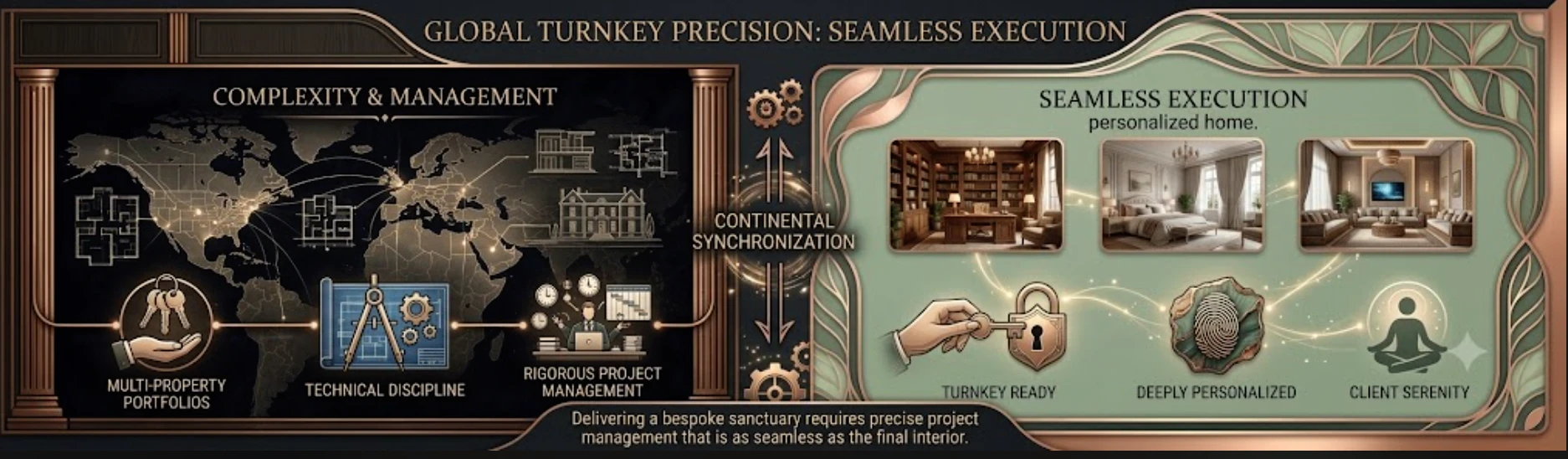
The Full-Cycle Design Journey
A successful turnkey luxury project follows a structured, transparent continuum:
Phase 1: Deep Discovery & Concept Strategy Uncovering the client’s psychological archetype, functional requirements, and personal aesthetic through detailed consultation and spatial mood boards.
Phase 2: Architectural Schematics & Spatial Planning Developing precise floor plans, ceiling layouts, custom millwork drawings, and technical lighting integration schemes.
Phase 3: Material Sourcing & Craftsmanship Coordination Procuring rare stones, custom textiles, and bespoke artisan pieces while managing international lead times and quality verification.
Phase 4: Detailed Technical Documentation Generating exhaustive engineering plans, MEP (mechanical, electrical, plumbing) coordination blueprints, and material execution schedules.
Phase 5: Design Supervision & Turnkey Delivery Providing continuous remote and on-site author’s supervision to ensure that every architectural detail aligns perfectly with the approved vision down to the last millimeter.
This full-spectrum oversight ensures that remote homeowners experience complete peace of mind, knowing their project is executed with absolute fidelity regardless of geographic location.
Living in Harmony with the Self
Designing for the soul is ultimately an act of deep self-awareness. A luxury home should not serve as an exhibition of wealth to the outside world; it should serve as a private sanctuary that honors how you live, think, rest, and create. By combining the precision of architectural engineering with the sensitivity of human psychology, modern luxury spaces transcend mere decoration. They become enduring, personal landscapes—crafted with uncompromising quality, grounded in timeless materials, and built strictly around the individual human spirit.
Related posts
Keratin Treatment Parkland: The Ultimate Guide to Frizz-Free Style in 2026
What if the secret to a perfect hair day wasn't a more expensive flat iron, but a technical climate-defense strategy designed specifically for the...
Why Fashion Business Graduates Need More Than a General Business Degree
Fashion operates on rules that a standard business education doesn't quite capture. Inventory cycles that other retail sectors measure ...
Silk Touch Keratin Treatment: The Ultimate Guide to Frizz-Free Hair in 2026
What if you could achieve glass-like shine and total humidity resistance without ever worrying about the safety of the ingredients in your stylist's...